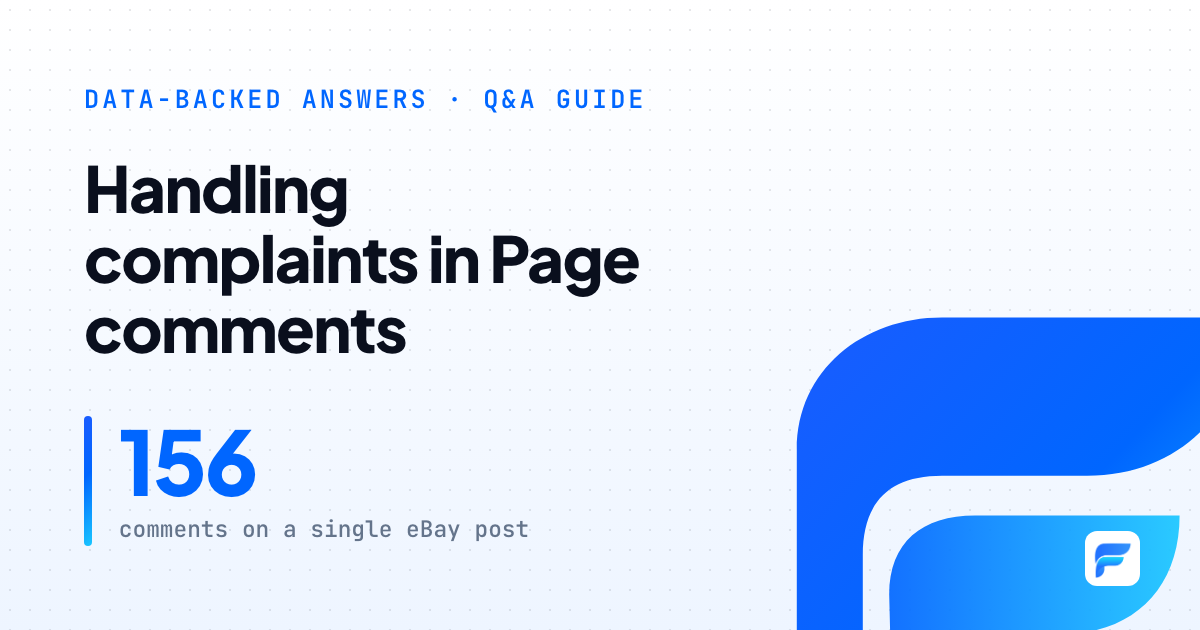
The short answer: most complaints on a Facebook Page are not about the post they sit under. They appear because customers cannot find another way to reach support. Fanpage Insight's report on eBay found that informational posts collect large comment volumes made up mostly of customer service escalations, complaints about automated bots, held funds and counterfeit listings; one post drew 156 comments. At the other end, Cocoon Vietnam is credited for replying to comments regularly and steering customers to private messages for follow-up.
This guide pulls together findings from 16 Pages whose reports flag complaints, skepticism or spam in comments, across consumer, real estate, media, finance and software. These are Page-level observations rather than statistics across a representative sample, so read them as case evidence, not laws.
01 · OverviewFour kinds of negative comments
The reports sort negative comments into four fairly distinct groups: service complaints (eBay, Airwallex Vietnam), reactions to late or unwelcome news (IBTE, Noble Palace Tay Thang Long), skepticism and sarcasm (CafeF, Sunshine Group, Review Bat Dong San) and spam or off-topic comments (Sunshine Continental, Imperia Sensa Park, TT GENESIS). Each needs a different response; a single reply script for all of them is a common mistake.
Pages with findings on negative comments
Summarised from each Page's analysis report
Show data table
| Page | Industry | Followers | What the report found |
|---|---|---|---|
| eBay | Consumer | 10,735,258 | Comments overwhelmed by support complaints |
| Cocoon Vietnam | Consumer | 426,716 | Strength: replies to comments consistently |
| IBTE | Consumer | 8,189 | Visitor rules announced close to the event |
| CafeF | Media | 1,949,207 | Sarcastic comments under macro news |
| Sunshine Group | Real estate | 20,076 | Skeptical comparisons with other developers |
| Noble Palace Tay Thang Long | Real estate | 6,289 | Price-rise post: 16 engagements, 0 comments |
| TT GENESIS by TT Capital | Real estate | 1,318 | Few comments, spam on top posts |
| Sunshine Continental | Real estate | 64 | Phone-number spam left visible |
| Airwallex Vietnam | Finance | 1,787 | Little direct customer care in comments |
Source: Fanpage Insight Page analysis reports, Sep–Oct 2026
02 · Service complaintsWhen the comment section becomes the help desk
eBay: support grievances take over comments on marketing posts
Informational posts receive high comment volumes made up mainly of customer service escalations, complaints about automated bots, held funds and reported counterfeit listings. One post received 156 comments.
Negative sentiment in the comments weakens community building and pulls attention away from the promotional message. Here, a high comment count is not a good sign.
The eBay report spells out the mechanism: users who cannot reach a human agent go to the marketing post, where they know the brand will see them. That applies to any large Page. If the official support channel is slow or hard to find, the comment section becomes the default support channel, in public.
Cocoon Vietnam: answer in public, continue in private messages
The Page replies to comments regularly, answers questions on products and promotions, and actively points customers to private messages for further advice. The audience asks about product details, prices and promotion terms, especially on sale posts.
Many questions on offer posts repeat. The report suggests turning them into an FAQ or an explainer post to take load off the comments.
Airwallex Vietnam shows the other side: its report notes a median of just 4 engagements on routine posts and reads the lack of direct replies as a sign of an operating process that is not yet optimised (see the Airwallex Vietnam teardown). For Sunshine River Park, the report counts 2,226 contact profiles, of which 810 had a Zalo account and 115 an email, which suggests messaging apps are the natural place to continue a conversation that starts in public comments.
What to do: reply publicly in one short line, acknowledge the issue and name the next step (message, hotline, form), then resolve it privately. Pin a comment or post explaining how to reach support on high-reach posts. Track the share of comments that are support requests as an operations metric, not just an engagement one.
03 · Late informationComplaints caused by late or unwelcome news
IBTE: an age rule announced close to the date drew negative reactions
The age limit for visitors (12 and over on certain days) at IBTE Hanoi 2026 was announced shortly before the event, prompting many negative comments about the late notice and disrupted plans.
Late or unclear communication about attendance rules can damage trust, especially for a Mother & Baby and Toys event that naturally attracts families with young children.
Noble Palace Tay Thang Long: a price-rise post met near silence
The post announcing a price increase received only 16 engagements and 0 comments, far below the Page's other posts.
Customers may be unhappy, or may simply not want to engage publicly with the news. The report suggests pairing price changes with a clear statement of added value.
What to do: publish anything that may inconvenience customers (attendance rules, price changes, schedule changes) as early as possible, pin it, and repeat it on related posts. When the news is unwelcome, explain why and what the customer still gets; do not let the notice stand alone.
See these numbers for your own Page
Paste any Page URL, even a competitor's. No admin access needed, report in minutes.
04 · SkepticismSkeptical comments: answer with facts, not arguments
Another group of negative comments targets market trust rather than service. On CafeF, stories about GDP growth or foreign tech achievements often attract sarcastic comments about land speculation and property prices. The report suggests that brands communicating macro news should tie it to concrete improvements in daily life, so it does not feel remote.
Skepticism is more frequent in real estate. Sunshine Group receives some comments comparing it with developers that had a poor reputation in the past; they are few, but the report warns they can shape wider perception if left unaddressed. On Review Bat Dong San, some comments doubt infrastructure timelines and quality; the report raises the possibility that answering them, or offering several viewpoints, could turn criticism into dialogue.
A Page can also balance its own tone. Bat Showbiz, an entertainment news Page, keeps a content pillar on celebrities' kind gestures, which its report credits with balancing community attitudes and keeping the Page from turning overly negative.
What to do: when a skeptical comment raises a specific point (timeline, legal status, price), answer with facts and a source; generic sarcasm usually does not need a reply. Do not delete comments simply because they disagree: that tends to create more doubt.
05 · SpamSpam is the most neglected kind of negative comment
Several real estate Pages in the sample have a problem not because customers are angry but because nobody moderates the comments. On Sunshine Continental, a comment containing a personal phone number stayed visible under a post about the project's location. Imperia Sensa Park has an entirely unrelated comment on an amenities post. At TT GENESIS by TT Capital, the kick-off post reached 2,787 reactions and 22 shares but few comments, while a post about WOW Center had 11 comments, including spam.
TT GENESIS: high engagement, but the comments need managing
Event and promotion posts draw many reactions and shares, but comment counts are low and include spam, negative or off-topic comments on the most visible posts.
The report recommends closer monitoring to answer questions, remove spam and handle negative comments quickly, while encouraging deeper discussion.
What to do: switch on keyword filters for phone numbers and common ad phrases, check the comments on high-reach posts during their first hours, and hide (rather than delete) comments containing personal data. A clean comment section keeps real customer questions visible. See also the Sunshine Continental and Imperia Sensa Park teardowns.
06 · WorkflowA complaint-handling workflow for Facebook Pages
- Triage comments into service complaints, reactions to news, skepticism and spam. One playbook per type.
- Service complaints: short public reply, acknowledge the issue, move to messages or a hotline for the details.
- Pin support contact details on high-reach posts so customers do not need marketing posts to complain.
- Publish and pin potentially inconvenient rules early (age limits, prices, schedules) and repeat them on related posts.
- Specific skeptical comments: answer with facts and sources, avoid emotional arguments.
- Spam and personal data: keyword filters, hide quickly, check high-engagement posts closely.
- Turn repeated questions into an FAQ or explainer post to reduce load on the comments.
To grow constructive comments alongside complaint handling, see Questions in captions: more comments, not more likes and the comparison Volvo Cars vs Mercedes-Benz Vietnam: reactions or conversations?
07 · FAQFrequently asked questions
Should a Page delete negative comments?
Only hide or delete spam, comments with personal data and content that breaks the rules. For genuine complaints, a public reply followed by a private channel usually works better: other readers can see the brand responded.
Should complaints be answered publicly or privately?
Both. The pattern recorded at Cocoon Vietnam is a public reply that answers the question and shows care, followed by a move to private messages for the details.
Why do marketing posts attract so many complaints?
According to the eBay report, customers post support requests on marketing posts when they cannot reach a human agent through other channels. A high-reach post is where they expect the brand to notice.
Is a post with no comments a safe post?
Not necessarily. The price-rise post at Noble Palace Tay Thang Long received 0 comments; the report suggests this may reflect avoidance or unspoken negative sentiment.
Methodology & data sources
This guide compiles findings on complaints, skepticism and spam in comments from the analysis reports of 16 Pages tracked on Fanpage Insight, produced in September and October 2026. Each finding is based on that Page's own public posts and comments. This is Page-level evidence, not a statistic representative of all Pages; findings labelled as hypotheses are phrased as possibilities.
- Data
- Public data from 16 Facebook Pages tracked on Fanpage Insight (consumer, real estate, media, finance, software)
- Period
- Reports produced 17 Sep to 27 Oct 2026; Vietnam time (GMT+7)
- Metric
- Engagement = reactions + comments + shares at collection time
- Limits
- Small sample selected for relevant findings; response times and complaint outcomes are not measured