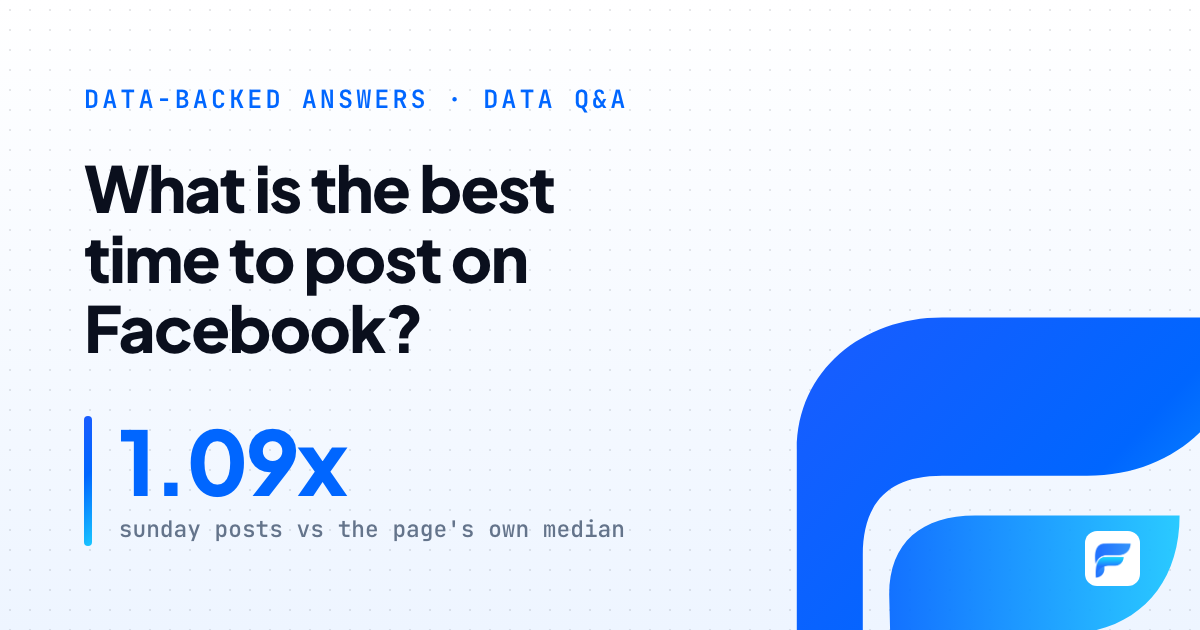
The short answer: posting time matters far less than most social media advice suggests. We compared 19,368 posts from 119 Facebook Pages tracked on Fanpage Insight between January and mid-November 2026. For most time slots and every weekday, posts landed exactly on their own Page's median (1.0x). The two clearest exceptions are late evening, 9pm to midnight (1.06x, ahead at 55% of Pages), and Sunday (1.09x, ahead at 59% of Pages).
At the other end, early-morning posts between 6 and 9am reached 0.96x, and posts between midnight and 6am 0.94x. These are differences of a few percent, not a doubling. A strong post published at 10am or 8pm will not fail because of the clock, and a weak one will not be rescued by clever scheduling.
01 · Time of dayTime of day: small gaps, with late evening slightly ahead
How to read the chart: for each Page we took the median engagement of posts published in a time slot and divided it by that Page's overall median. A value of 1x means posts in that slot performed exactly as usual for the Page. Comparing each Page with itself puts a national newspaper with millions of followers and a property developer with a few thousand on the same scale.
Engagement by time slot, relative to each Page's own median
Median across Pages; Vietnam time (GMT+7)
Source: public data from 119 Facebook Pages tracked on Fanpage Insight, January–November 2026
Five of the seven slots come out at 1.0x. Late evening is the only slot above the line, and the share of Pages where it beat the usual level, 55%, is barely more than half. So this is a mild tendency rather than a consistent pattern: close to half of the Pages that post late saw no gain. The early-morning and overnight slots sit below the line, but only 18 Pages had enough overnight posts to compare, so that figure should be read with caution.
What to do: stop spending effort on finding the perfect minute. If your Page has never tried the 9pm-to-midnight window, it is a cheap test worth running, but treat it as a hypothesis to check against your own numbers, not a rule.
02 · Day of weekDay of the week: weekends edge ahead, weekdays are identical
Engagement by day of posting, relative to each Page's own median
Median across Pages
Source: public data from 119 Facebook Pages tracked on Fanpage Insight, January–November 2026
Monday through Friday, posts perform exactly at the Page's usual level (1.0x). Saturday edges up to 1.04x and Sunday to 1.09x, with 55% and 59% of Pages respectively seeing better-than-usual results. That makes the weekend the most consistent timing signal in the whole dataset, even if the gap is still modest.
One detail stands out: only 83 Pages published enough on Sundays to be compared, against 114 to 117 Pages on weekdays. Many brands, B2B Pages in particular, barely post at weekends. A plausible explanation is that weekend feeds carry fewer brand posts, so each one competes with less. That is a hypothesis; the data cannot establish the cause.
The weekend is an empty slot, not a gold mine
Sunday posts reached 1.09x their Page's own median and beat the usual level at 59% of the 83 Pages with enough Sunday posts. Saturday came in at 1.04x across 101 Pages.
If your team only publishes on weekdays, move one or two scheduled posts a month to the weekend and compare them with your Page's usual level.
03 · Posting habitsWhen Pages actually publish
The table puts two things side by side: the share of all posts in the sample that went out in each slot, and how that slot performs against each Page's usual level.
Share of posts and relative engagement by time slot
Vietnam time (GMT+7)
Show data table
| Time slot | Share of posts | vs Page median | Pages compared |
|---|---|---|---|
| Midnight–6am | 2.5% | 0.94x | 18 |
| 6am–9am | 8.4% | 0.96x | 72 |
| 9am–noon | 22.3% | 1.0x | 105 |
| Noon–3pm | 15.5% | 1.0x | 105 |
| 3pm–6pm | 18.1% | 1.0x | 106 |
| 6pm–9pm | 20.9% | 1.0x | 95 |
| 9pm–midnight | 12.3% | 1.06x | 66 |
Source: public data from 119 Facebook Pages tracked on Fanpage Insight, January–November 2026
The late morning is the busiest slot, with 22.3% of all posts, followed by early evening with 20.9%. Both perform exactly at the usual level. Late evening carries just 12.3% of posts yet is the only slot above the line. The picture suggests that the hours most often recommended in generic advice, such as lunchtime or the commute home, have become the most crowded ones.
The slot where most Pages publish is not the slot where posts do best.Data from 19,368 posts, Fanpage Insight
What to do: rather than competing in the late-morning rush with everyone else, spread some posts into quieter slots and measure the outcome. For important posts, such as a product launch or the opening of event registration, let the campaign calendar decide the timing, not a generic best hour.
See these numbers for your own Page
Paste any Page URL, even a competitor's. No admin access needed, report in minutes.
04 · Reading the dataWhy there is no single best time for every Page
Most best-time advice is built on total engagement by hour across a platform. That method has two problems. First, big Pages dominate it: a newspaper with millions of followers posting heavily in the morning makes the morning look golden. Second, crowded hours collect more total engagement simply because more posts go out then. Comparing each post with its own Page removes both distortions.
Most timing differences are within a few percent
Five of seven time slots and all five weekdays come out at 1.0x each Page's own median. The highest value is 1.09x (Sunday) and the lowest 0.94x (midnight to 6am).
Time spent optimising posting hours is better spent on topic, format and calls to action, where differences between posts are much larger.
That does not make timing irrelevant. Individual Pages can have audiences with their own rhythms: followers of a finance news Page may read early, while people browsing a resort development may scroll late at night. The aggregate data only tells you that no slot wins across the board; it cannot replace your own Page's numbers.
05 · How to testHow to find the right posting time for your own Page
Because the overall differences are small, the most reliable approach is to test on your own Page, using the same within-Page comparison as this study.
- Use your Page's median engagement per post over the last three months as the baseline.
- Pick two slots to test, for example the familiar late morning and the quieter 9pm-to-midnight window.
- Publish similar content in the same format in both slots, so that timing is the main difference.
- Run the test for several weeks before drawing conclusions; one viral post proves nothing.
- Add one or two weekend posts a month if your Page currently publishes only on weekdays.
- Track the share of comments and shares as well as total engagement.
- Review the results every quarter; audience habits shift with the seasons.
If you want to look beyond timing, content and format rules usually matter more. See our playbook of 7 rules for Facebook Page posts and the analysis of questions in captions for levers with a clearer effect.
06 · FAQFrequently asked questions
What time should I post on Facebook?
There is no universal best time. In 2026 data, 9pm to midnight comes out slightly ahead (1.06x each Page's own median), while every slot from 9am to 9pm sits at 1.0x. Test on your own Page.
Is it worth posting on weekends?
The data supports trying it. Sunday posts reached 1.09x and Saturday posts 1.04x the Page's usual level, while many Pages do not post at weekends at all.
Do early-morning posts perform better?
Not in this sample. Posts between 6 and 9am reached 0.96x the usual level, and only 36% of Pages saw better-than-usual results.
Does my industry have its own best time?
Possibly, but industry-level samples get small quickly. A more reliable approach is to compare your own Page's posts by time slot over a few months.
Methodology & data sources
The analysis uses public data from 119 Facebook Pages tracked on Fanpage Insight: 19,368 posts published between 1 January and mid-November 2026. For each Page, the median engagement of posts in a given day or time slot was divided by that Page's overall median; the figures shown are the median across Pages. The share of Pages ahead is the percentage of Pages where that group beat the Page's usual level. A Page counts for a slot only when it has enough posts in it, so the number of Pages varies by row; the overnight slot covers only 18 Pages.
- Data
- 19,368 posts from 119 Facebook Pages tracked on Fanpage Insight
- Period
- 2026-01-01 to 2026-11-18
- Metric
- Engagement = reactions + comments + shares, relative to each Page's own median
- Time zone
- Vietnam time (GMT+7)
- Limits
- Correlation, not causation; the number of Pages differs by slot